Diesel Price at ₹95.20: What a Hike Would Cost Your Truck
 By Vikram SinghOctober 22, 20265 min read
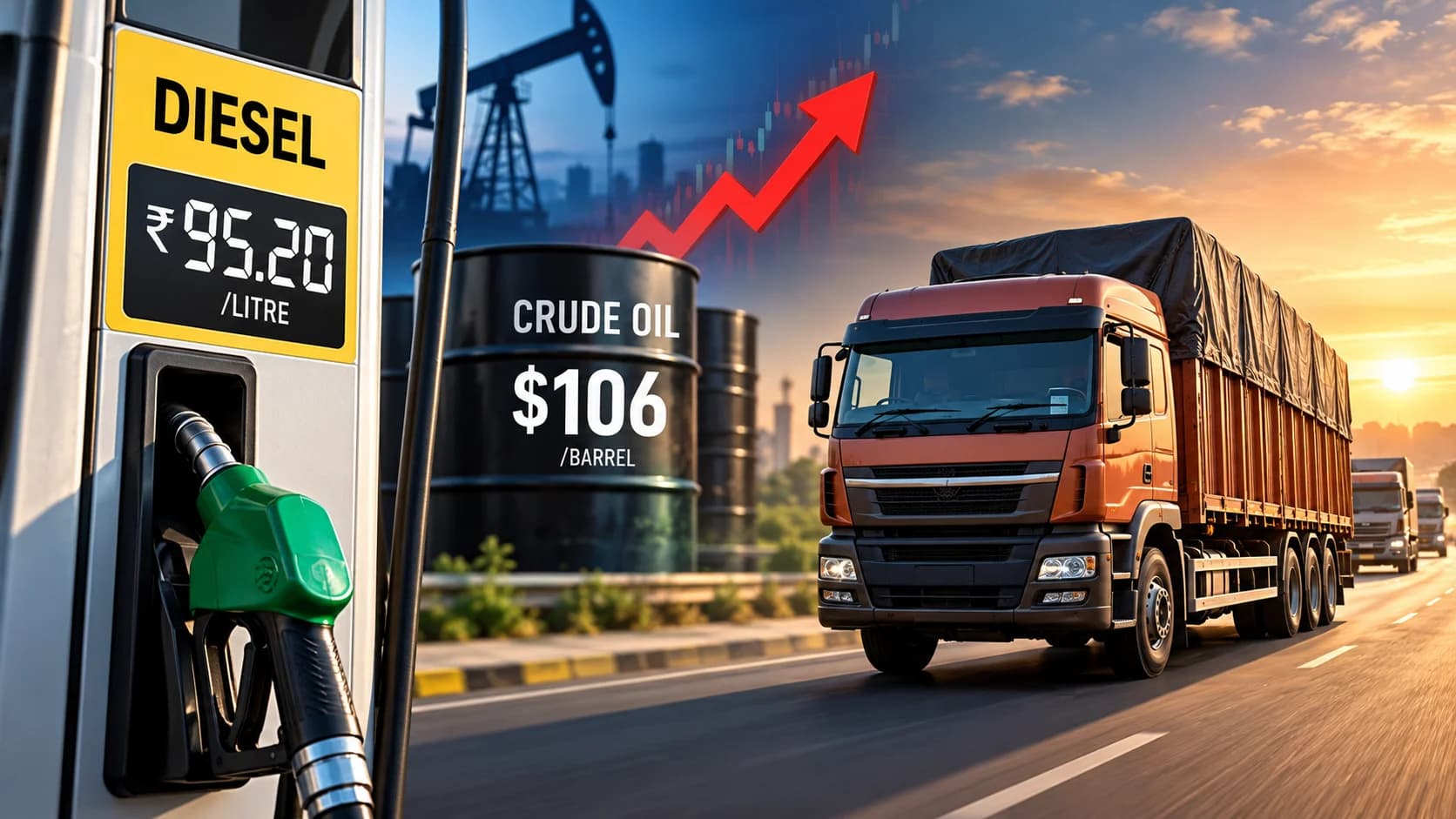
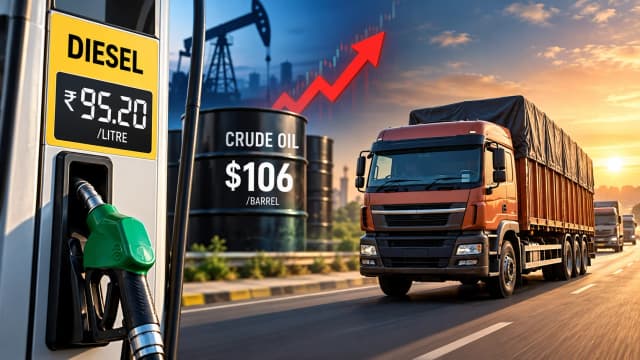
The diesel price in Delhi has sat at ₹95.20 a litre since May, even though crude has climbed past $106 a barrel. That calm may not last. If you run a 28-tonne truck 10,000 km a month, every ₹1 rise costs you roughly ₹2,500 more each month. So now's the time to work out your exposure.
Why the diesel price hasn't moved since May
The last increase came on 25 May, when Delhi's rate went from ₹92.49 to ₹95.20. That was the fourth hike in about ten days, and together they added roughly ₹7.50 a litre, according to Discovery Alert. Since then, the state-run companies have held prices steady.
However, the gap is widening. Brent crossed $106 on 14 October after attacks on Saudi oil targets, BusinessToday reported. ICRA also estimated that Indian Oil, BPCL and HPCL were losing about ₹9 on every litre of diesel in September. Meanwhile, private retailers Jio-bp and Nayara have already raised their prices.
Nobody has announced a hike, so don't treat one as certain. Still, a ₹9-a-litre hole can't stay open forever.
Diesel price by city today
Where you fill up already matters more than you might think. On 14 October, a litre of diesel cost ₹95.20 in Delhi but ₹104.23 in Hyderabad, because state VAT differs. Mumbai was at ₹97.83, while Kolkata, Chennai and Bengaluru all sat between ₹99.55 and ₹99.82.
That ₹9 gap between Delhi and Hyderabad is as big as the hike everyone's worried about. So on an interstate route, filling in the cheaper state is the easiest saving you'll find.
Prices, EMIs, subsidies and permit rules vary by state and change frequently. Verify with your dealer, lender or RTO before you buy.
What a diesel price hike adds to your monthly bill
We ran three typical trucks at Delhi's ₹95.20. For the mini truck, we used Tata's claimed 22 km per litre for the Ace Gold diesel. For the bigger trucks, however, we used round example figures of 8 km/l and 4 km/l, so plug in your own mileage.
| Truck (monthly km) | +₹2/litre | +₹5/litre | +₹9/litre |
|---|---|---|---|
| Mini truck, 22 km/l (2,500 km) | ₹230 | ₹570 | ₹1,020 |
| ICV, 8 km/l (6,000 km) | ₹1,500 | ₹3,750 | ₹6,750 |
| HCV, 4 km/l (10,000 km) | ₹5,000 | ₹12,500 | ₹22,500 |
For a mini truck, even the worst case is an annoyance rather than a crisis. For a long-haul HCV, on the other hand, a ₹9 hike is about ₹2.7 lakh a year. That can wipe out a thin margin on a fixed-rate contract.
At today's price, the fuel bill already runs to about ₹4.33 per km on the mini truck and ₹11.90 on the ICV. On the HCV, it's ₹23.80 per km.
Prices, EMIs, subsidies and permit rules vary by state and change frequently. Verify with your dealer, lender or RTO before you buy.
How to protect yourself from the next diesel price rise
Start with your contracts. If you're signing a fixed freight rate for six months or a year, add a diesel escalation clause linked to the pump price. Many shippers will agree to one, because they'd rather pay a fair adjustment than lose a reliable transporter.
Next, plan where you fill up. Running Delhi to Hyderabad, for example, it makes sense to fill up at the cheaper end. Also, keep the tank only as full as the route needs, since you can't control the hike date.
Then fix the basics on the truck. Correct tyre pressure, less idling at loading points and a clean air filter all add up. In fact, a 5% mileage gain on an HCV covers most of a ₹5 hike.
Finally, if you run short city routes, look again at the alternatives. CNG has its own problems, as our CNG price hike explainer shows. By contrast, an electric mini truck now costs about a quarter as much per km on depot power.
What this means for buyers
- Budget for a diesel price rise now, even though none is announced. A ₹5 cushion is a sensible planning figure for the next six months.
- Put escalation clauses in every new freight contract, because that's the one cost you can pass on.
- If you're about to buy an HCV, fuel efficiency is worth paying for. Every 0.5 km/l counts at 10,000 km a month.
- For long-haul operators, the proposed age extension for CNG and EV trucks is also worth reading before you pick a fuel.
Diesel price FAQs
What is the diesel price in Delhi today?
It's ₹95.20 a litre at state-run pumps, unchanged since 25 May 2026.
Will the diesel price go up?
Nobody has announced a hike. However, ICRA estimates the oil companies lost about ₹9 a litre on diesel in September, and Brent is above $106, so pressure is building.
Which city has the costliest diesel?
Among the six big cities BusinessToday tracks, Hyderabad is highest at ₹104.23 a litre. Delhi, by contrast, is cheapest at ₹95.20.
How much does a ₹1 diesel hike cost a truck owner?
It depends on mileage and distance. For example, an HCV doing 4 km/l over 10,000 km a month pays about ₹2,500 more.