BS7 Norms for Trucks: What the 2031 Draft Means for You
 By Vikram SinghOctober 22, 20266 min read
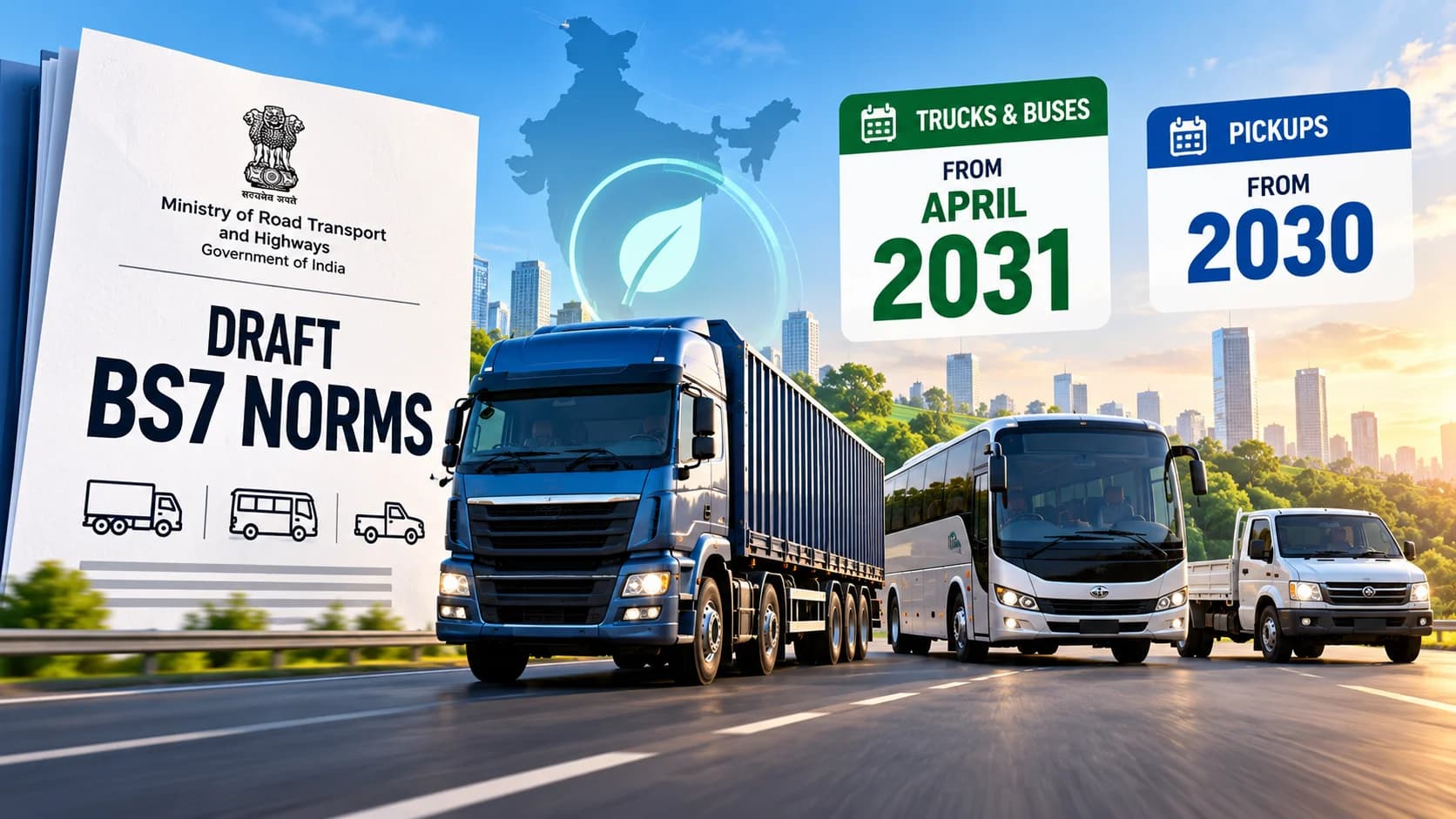
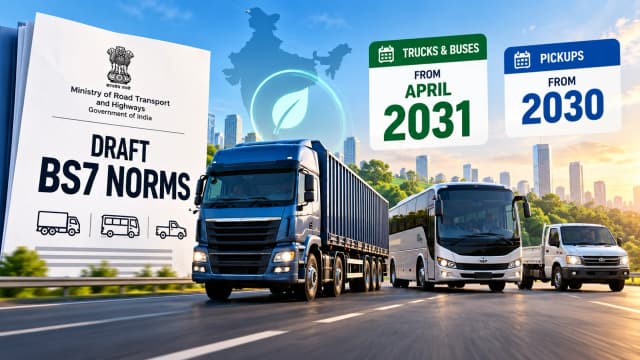
BS7 norms for trucks and buses are now on paper. The transport ministry's draft says new trucks and buses must meet them from 1 April 2031, and light goods vehicles a year earlier. So if you're buying a BS-VI truck this festive season, you still have about four and a half years before anything changes on the showroom floor.
That said, the rules are tougher than the headline suggests. The tailpipe limits barely move. However, your truck will have to stay within them for far longer, and it will report on itself when it doesn't.
When BS7 norms for trucks and buses kick in
The Ministry of Road Transport and Highways (MoRTH) published two draft notices amending Rule 115 of the Central Motor Vehicles Rules. G.S.R. 881(E), dated 12 October 2026, covers light goods vehicles (N1). G.S.R. 882(E), dated 13 October 2026, covers buses and trucks in the M2, M3, N2 and N3 categories, according to F&L Asia.
Each category gets three phases. Here's the timetable as Autocar Professional reported it:
| Category | Phase 1 | Phase 2 | Phase 3 |
|---|---|---|---|
| Cars and SUVs (M1) | Apr 2029 | Apr 2031 | Apr 2035 |
| Pickups and small trucks (N1) | Apr 2030 | Apr 2032 | Apr 2035 |
| Buses, ICVs, HCVs (M2, M3, N2, N3) | Apr 2031 | Apr 2033 | Apr 2035 |
You may have seen "BS7 from April 2029" in the news. That date is for passenger cars only. Commercial vehicles follow later, and BusinessToday also describes heavy trucks and buses as completing the shift by 2035.
What changes under the BS7 norms for trucks
Surprisingly, the main tailpipe limits for CO, NOx and particulate matter stay where they are under BS-VI. Instead, the draft changes how those limits are measured and for how long you must meet them.
- Particle counting drops from 23 nanometres to 10 nanometres, so finer soot that BS-VI tests ignore will now count.
- For trucks and buses, ammonia gets its own limit on the lab test. That matters because AdBlue-based SCR systems can slip ammonia when they're badly tuned or dosed.
- Methane and nitrous oxide also come into scope for commercial vehicles, which affects CNG and LNG trucks in particular.
- An on-board monitoring system must flag emissions at 2.5 times the limit or more.
The monitoring part is the real shift. From 1 April 2031, that data must be readable through the OBD port on trucks and buses. Then, from 1 April 2033, it must also be shared anonymously over the air. In practice, a truck with a tampered or failing aftertreatment system will be much harder to hide.
A truck that must stay clean for 7 lakh km
Durability is where BS7 bites hardest. For the heaviest trucks and buses, the draft sets a main lifetime of 7,00,000 km or 12 years. Your engine and exhaust system must meet the limits across that whole life, not just when it's new.
Light goods vehicles get a main lifetime of 1,60,000 km or 8 years. On top of that, there's an additional lifetime that stretches to 2,00,000 km or 10 years. Think of a Bolero Pik-Up or a Dost doing city deliveries, and you'll see why that matters: many of them cross 2 lakh km well before year ten.
The draft also brings in an Environmental Vehicle Passport, which records emissions, energy use and, where relevant, battery health. For a used-truck buyer, that could become the most useful document in the file.
Will BS7 norms make trucks costlier?
Almost certainly, but nobody has put a number on it yet. Neither the draft nor the coverage so far gives a price estimate, so be wary of anyone quoting one.
Still, you can see where the cost will come from. Meeting the same limits for 7 lakh km means longer-lasting catalysts, better sensors and tighter SCR control. Meanwhile, the monitoring hardware and software add cost too. Industry executives have already warned that the R&D effort could delay new launches and EV programmes.
Remember also that BS7 isn't the only thing pushing truck prices up. Emergency braking becomes compulsory on new trucks first, as we explained in our piece on ADAS for trucks and buses from 2027.
Prices, EMIs, subsidies and permit rules vary by state and change frequently. Verify with your dealer, lender or RTO before you buy.
Should you buy a BS-VI truck now?
Yes, if the numbers work for your routes. BS7 applies to vehicles manufactured after the cut-off date, so a BS-VI truck registered today stays legal for its full life under the emission rules. Nothing in this draft forces you off the road.
On the other hand, watch the city-entry rules. Delhi stops letting outside BS-IV goods vehicles in from 1 November 2026, as covered in our Delhi BS4 truck ban explainer. Older norms tend to get squeezed out of big cities first, so a BS-VI truck bought in 2026 could face similar pressure in the late 2030s. For a five-to-seven-year haulage cycle, though, that's well beyond your horizon.
If you're weighing an electric truck instead, BS7 doesn't change that maths much. Our guide to electric truck prices and the PM E-DRIVE incentive is the better place to start.
What this means for buyers
- Don't delay a planned BS-VI purchase over BS7. Commercial vehicle dates start in 2030 for pickups and in 2031 for everything heavier.
- Look after your SCR and DPF now. A truck with a record of clean emissions will resell better once buyers start asking for emissions history.
- Expect a price step-up around 2030–31, so if you plan to grow your fleet, the BS-VI years before that are the cheaper window.
- Treat every date here as provisional, because this is still a draft.
BS7 norms for trucks: FAQs
When do BS7 norms for trucks start?
Under the draft, new medium and heavy trucks and buses must comply from 1 April 2031. Light goods vehicles, such as pickups, start a year earlier, on 1 April 2030.
Will my BS-VI truck be banned when BS7 arrives?
No. The draft covers newly manufactured vehicles. However, city-level entry rules, like Delhi's on BS-IV trucks, are set separately and can change.
Are the BS7 dates final?
Not yet. MoRTH has invited objections and suggestions within 30 days of the gazette copies being made public, so the dates could still shift before the final rule.
Do the BS7 norms cover CNG trucks?
Yes. In fact, the commercial vehicle drafts add methane and nitrous oxide to the scope, both of which matter more for gas engines than for diesel ones.