Mahindra Blazo i-TRK: Mileage Claim and Uptime Guarantee

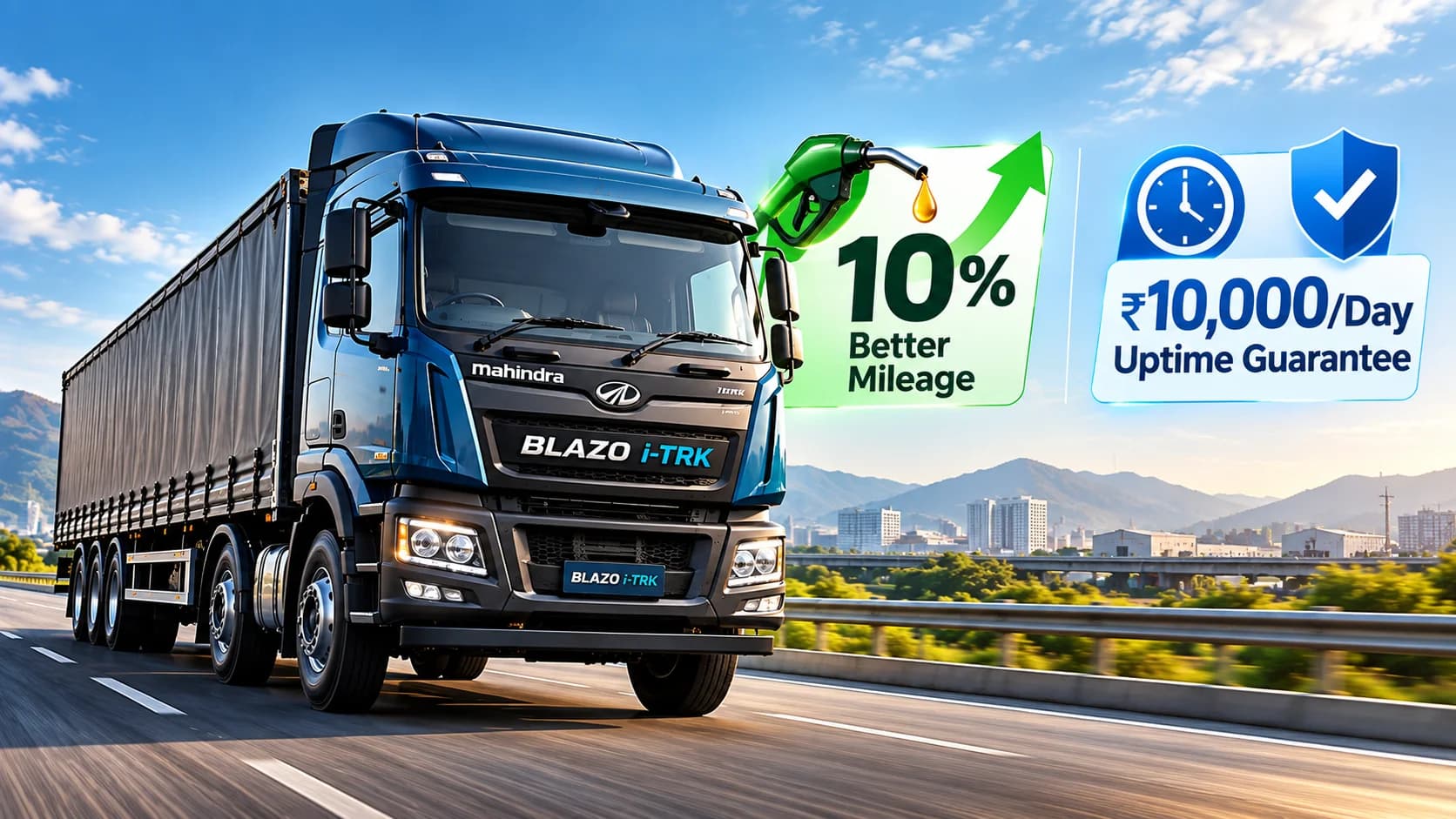
The Mahindra Blazo i-TRK promises two things a fleet owner actually counts: up to 10% better mileage, and a 48-hour uptime guarantee backed by ₹10,000 for every extra day off the road. Mahindra says that adds up to as much as ₹15 lakh more profit per truck over five years.
That's a bold claim. So what's it worth on your own numbers, and what should you check before you sign?
What the Mahindra Blazo i-TRK brings
Mahindra Truck and Bus launched the range on 14 August. It uses the 7.2-litre mPOWER engine, which makes 320 hp and 1,100 Nm between 1,100 and 1,700 rpm. A nine-speed gearbox is available, with a 430 mm heavy-duty clutch.
On the tech side, there's an AI-based drive mode called iFuelSmart, the iMAXX 2.0 telematics platform, and an optional driver-monitoring camera. The cab gets a suspended seat, cruise control and factory AC. For long-haul drivers who sleep in the cab, those last two matter more than they sound.
Mahindra hasn't published prices, so ask your dealer for a written quote on your exact configuration.
Is 10% better mileage worth ₹15 lakh?
Let's test it. Take a haulage truck that runs 1 lakh km a year at 3.5 km/l, with diesel at about ₹90 a litre. These are illustrative numbers, so use your own.
At 3.5 km/l, the truck burns roughly ₹25.7 lakh of diesel a year. If the i-TRK really does 10% better, at 3.85 km/l, that falls to about ₹23.4 lakh. So the saving is around ₹2.3 lakh a year, or about ₹11.7 lakh over five years.
That's close to Mahindra's ₹15 lakh figure. The rest of its claim presumably comes from uptime and lower maintenance. Still, note the words "up to". Real mileage depends on load, route and driver, so the full 10% shows up only on good highway runs with a trained driver.
Prices, EMIs, subsidies and permit rules vary by state and change frequently. Verify with your dealer, lender or RTO before you buy.
The Mahindra Blazo i-TRK uptime guarantee
This is the part that's genuinely new in Indian trucking. If the truck breaks down and isn't back on the road within 48 hours, Mahindra pays ₹10,000 a day, subject to terms and conditions.
To back it up, Mahindra says it has quick-service points within 75 km on national highways and 50 km on state highways. It also guarantees supply of 250 critical parts.
However, the fine print matters. Before you buy, ask for the terms in writing and check four things:
- Does the clock start at breakdown, or when the truck reaches the workshop?
- Are accident damage, tyres and driver error excluded? They usually are.
- How many years, or km, does the guarantee last?
- Is there a cap on the total payout per year?
Even with limits, though, ₹10,000 a day is a strong signal. A maker doesn't promise that unless it trusts its service network.
How it compares with rivals
Tata, Ashok Leyland and BharatBenz all sell haulage trucks in this power class with telematics, and Tata and Ashok Leyland in particular have long-established service networks. So compare workshop reach on your own routes before you choose.
Where it stands out is the written uptime promise. Rivals offer service-time targets, but a cash payout per day is rarer. If your trucks run long distances where a breakdown costs you a load, that's worth a real premium.
So who does it suit best? In our view, it's the owner of three to ten trucks on long interstate runs, say Ludhiana to Kolkata or Mundra to Delhi. A single breakdown there can cost a load and a client. Large fleets with their own workshops, by contrast, will value the guarantee less.
Demand for heavy trucks is also at a record. As our report on CV sales in September 2026 shows, HCV retail jumped 46%, so expect limited room on price at every brand.
What this means for buyers
- Run the mileage maths on your own route and load before you count on the full 10%.
- Get the uptime guarantee terms in writing, and check the nearest Mahindra service point on your main route.
- Compare the on-road price and finance offer with Tata and Ashok Leyland on the same spec. Also, the RBI's latest hike adds to your CV loan EMI.
- Planning to buy in 2027? New models will need emergency braking from January, so ask whether the i-TRK already meets the ADAS rules for trucks.
FAQs on the Mahindra Blazo i-TRK
What engine does the Mahindra Blazo i-TRK use?
The 7.2-litre mPOWER diesel, with 320 hp and 1,100 Nm of torque.
What is the Mahindra Blazo i-TRK uptime guarantee?
If the truck isn't back on the road within 48 hours of a breakdown, Mahindra pays ₹10,000 per day, subject to terms.
What is the Mahindra Blazo i-TRK price?
Mahindra hasn't published prices. Ask your dealer for an on-road quote for your configuration.