Delhi BS-IV Truck Ban from 1 Nov 2026: Who's Affected
By AdityaSeptember 25, 2026
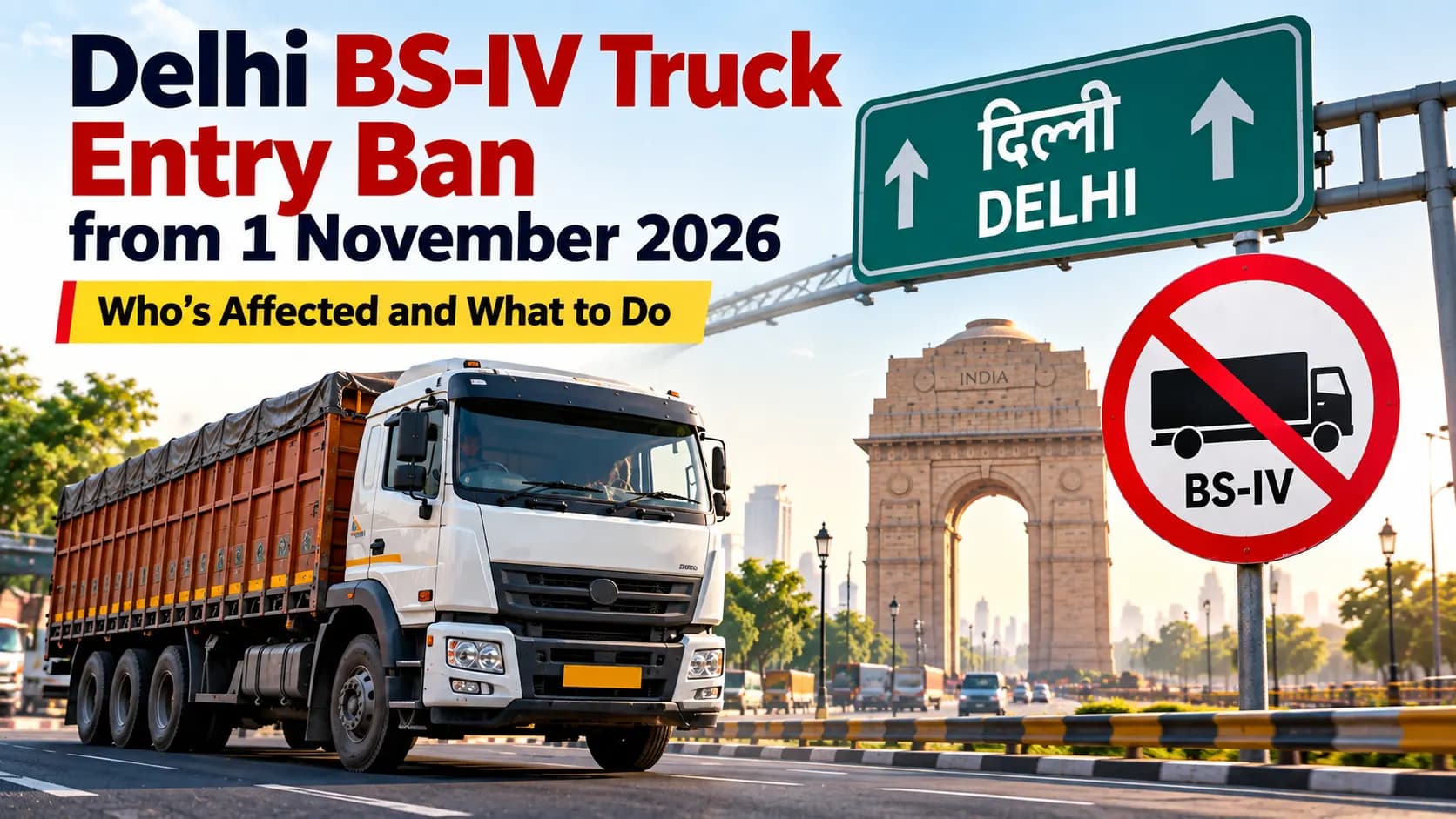
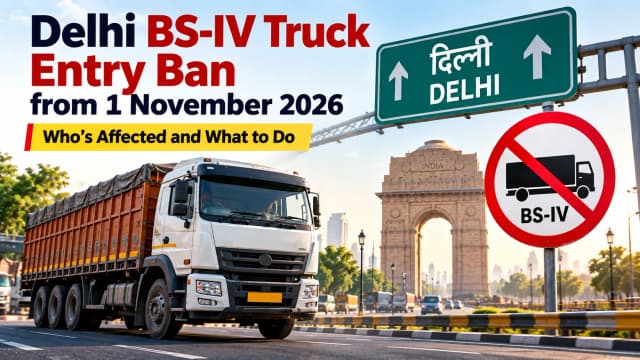
The Delhi BS-IV truck ban kicks in on 1 November 2026. From then on, BS-IV diesel goods vehicles registered outside Delhi can't enter the city, because the one-year grace period that the Commission for Air Quality Management (CAQM) gave BS-IV trucks runs out on 31 October. After that, only BS-VI, CNG, LNG and electric goods vehicles get in, along with anything registered in Delhi itself.
So if you run a BS-IV LCV, ICV or HCV on a UP, Haryana or Rajasthan number and any of your trips touch Delhi, you've got about five weeks to sort it out.
What the Delhi BS-IV truck ban actually says
CAQM first signed off on the restriction on 17 October 2025, using Section 12(1) of the CAQM Act, 2021. Then the Delhi Transport Department issued the public notice. As a result, it came in two stages:
- From 1 November 2025, BS-I, BS-II and BS-III goods vehicles registered outside Delhi were kept out.
- From 1 November 2026, BS-IV joins that list, because its transitional permission ends on 31 October 2026.
It covers light, medium and heavy goods vehicles. Also, what matters is where the truck is registered, not where you live or where the load is headed.
Essential goods aren't spared either. Trucks carrying essential commodities had their own exemption, but that also ends on 31 October, according to The Tribune. The paper also noted that about 40% of trucks entering Delhi carry essential supplies. As a result, milk, sabzi and FMCG routes will feel this the most.
So far, as of 25 September 2026, we couldn't find any notice pushing the deadline back.
Who the Delhi BS-IV truck ban still lets in
| Goods vehicle registered outside Delhi | Entry from 1 Nov 2026 |
|---|---|
| BS-VI diesel or petrol | Allowed |
| CNG, LNG or electric | Allowed |
| BS-IV diesel | Not allowed |
| BS-III and older | Not allowed (since 1 Nov 2025) |
Delhi-registered trucks sit outside this rule altogether. However, they still have to follow Delhi's separate age limits and end-of-life vehicle rules.
GRAP restrictions also apply on top of all this. When a higher stage of the Graded Response Action Plan is in force on bad-air days, even compliant trucks can face extra curbs.
Prices, EMIs, subsidies and permit rules vary by state and change frequently. Verify with your dealer, lender or RTO before you buy.
How the Delhi BS-IV truck ban will be enforced
When stage one began last November, the transport department and traffic police set up 23 teams working in two shifts round the clock. Staff from Delhi and Haryana manned more than 120 checkpoints, including Kundli, Tikri, Rajokri, Aya Nagar, Kalindi Kunj, Kapashera and the Bajghera toll on the Dwarka Expressway. So we'd expect at least the same for the BS-IV stage.
In practice, a non-compliant truck simply gets turned back at the border. For a loaded vehicle, then, that means a wasted trip, a missed slot and usually a transshipment bill on top.
Does the Delhi BS-IV truck ban hit your truck?
Your truck falls under the ban only if all three are true. Firstly, it's a goods vehicle, not a bus. Secondly, the RC shows an RTO outside Delhi. Thirdly, its emission norm is BS-IV. Generally, diesel goods vehicles registered between April 2017 and March 2020 are BS-IV. Still, check the norm printed on the RC or in Vahan rather than going by the year.
If it runs on CNG, LNG or electricity, you're fine, because the emission norm doesn't come into it.
Your options before 31 October
Split the trip at the border
When Delhi is only a small slice of your work, the cheapest answer may be handing the load to a compliant vehicle at a hub like Kundli or Ghazipur, or at a warehouse on the Haryana or UP side. Compare that handling cost per trip with the EMI on a new truck before deciding.
Replace it with a BS-VI diesel
This is the easiest like-for-like swap, because you keep the same payload class and fuel network, and drivers need no retraining. Also, GST on trucks dropped from 28% to 18% in September 2025, so ask the dealer to show the GST line separately and check the discount hasn't quietly shrunk.
Switch to CNG
CNG trucks are exempt whatever their emission norm, while Delhi's CNG network is dense too. That said, running costs have climbed. Delhi CNG is now ₹86.98 a kg after this year's CNG price hike, so work out cost per km on your own routes first.
Go electric on fixed city routes
For short, predictable runs, especially when the truck is back at the depot every night, electric gets permanent entry and the cheapest energy per km. Meanwhile, the PM E-DRIVE e-truck incentive now runs to 31 March 2028. However, it needs a scrappage certificate, which your old BS-IV truck can provide.
Prices, EMIs, subsidies and permit rules vary by state and change frequently. Verify with your dealer, lender or RTO before you buy.
Sell it somewhere Delhi doesn't matter
A BS-IV truck is still legal across most of India, so it keeps its value better in markets away from the NCR. If you're going to sell, doing it before November, while buyers still see a Delhi-capable truck, usually fetches more.
What this means for buyers
Start with a simple fleet list: every truck, its registration state, its emission norm and how many Delhi trips it makes a month. That alone will tell you how exposed you are, so do it this week.
Don't pick up a used BS-IV goods vehicle for NCR work, however cheap it looks. Also, book any replacement early, since everyone with the same problem will be at the dealer in October. If you're going electric, scrap the old truck rather than selling it, because the scrappage certificate is what gets you the PM E-DRIVE incentive.
Delhi BS-IV truck ban: FAQs
Does the Delhi BS-IV truck ban apply to Delhi-registered trucks?
No, because it only covers goods vehicles registered outside Delhi. Delhi-registered trucks still follow the city's separate age and end-of-life rules.
Are BS-IV CNG trucks affected?
No. CNG, LNG and electric goods vehicles can enter whatever their registration state, so a BS-IV CNG truck is fine.
Does the rule cover trucks carrying essential goods?
Yes, from 1 November 2026. Their temporary exemption also ends on 31 October.
Does the ban cover buses?
This rule is for goods vehicles only, whereas buses fall under separate CAQM directions.